
Computer scientist, businessman and government adviser
By Barbara Ainsworth (Curator, Monash Museum of Computing History, Faculty of Information Technology, Monash University, Australia)
Introduction
Edward Trevor Robinson (always known as Trevor) had a major impact on the Australian computer industry for nearly 60 years. He was a leading
figure with Control Data Australia from when it was established in the early 1960s. He combined a thorough understanding of digital
computers with an awareness of the needs of customers ranging from research scientists, business installations and government departments in
both data processing and military requirements. In retirement, he advised government authorities and shared his knowledge with new companies
and students. Trevor Robinson was awarded the Pearcey Medal in 1999 in recognition of his contributions to the local computing
industry.
Early life and education
Edward Trevor Robinson was born on 22 June 1922 at Port Hedland, in the Pilbara Region, Western Australia to Vivian Albert Robinson and his wife Emily. The family lived on a large sheep station called Coogan which was located between Port Hedland and Marble Bar. The Robinson family had established the station in the 1890s. Trevor grew up on the property and went to board at Wesley College, Perth at 11 years old. He entered the University of Western Australia in 1940 and started his Bachelor of Science. Trevor’s father retired from active management of Coogan Station in 1940; V.A. Robinson and his wife Emily moved south to a smaller farm at Burekup, east of Bunbury. [13]
Career
World War Two 1942-1946
Trevor entered university when Australia was already fighting in World War Two. Aged 20 years, he decided to interrupt his studies in 1942 at the end of his third year and enlist in the RAAF. He was selected to receive special training in the very secret, new technology of radar. He undertook a six-month course in the School of Physics, University of Sydney. These were run by Professor Victor A. Bailey and the lecturers were drawn from the Physics Department.[8] The course attendees became known as the “Bailey Boys”. Over 300 men, usually with some university training already, attended the radar courses which were run from Sept 1941 to March 1944. They were taught a wide curriculum including aspects of circuit theory, variations of aerials, vacuum tubes (valves), Fourier theory and pulse technology. The courses were three or six months and participants underwent rigorous testing on their knowledge. The selection process brought together an interesting group. Trevor was on the 2nd course along with John Makepeace Bennett. Charles Hamblin also completed this course.[4] Both Bennett and Hamblin had significant careers associated later with Australian electronic digital computing. In January 1943 Trevor attended RAAF Radio School and was then posted as Commanding Officer of radio stations at Geraldton, WA and then in New Guinea. He was officially discharged with the rank of Flight-Lieutenant on 21 May 1946.[12]
CSIRO, Dept of Supply and Dept of Defence
After discharge, Trevor returned to the University of Western Australia and completed his university course with a 1st class Honours Degree in Physics. He then moved to work for the CSIRO Radio Board as a Research Officer with a placement at Mount Stromlo in 1952. It was at this point he was approached by the Defence Signals Bureau (DSB) which was a Government group involved in code breaking. They wanted him to work with aerials but he suggested that he could work on the new technology called electronic digital computing. Coincidentally the DSB needed new codebreaking equipment and had already discussed the provision of a digital computer for Australia with their English counterpart Government Communications Headquarters or GCHQ. The English group suggested a version of their new machine known as COLOROB which was built by GCHQ engineers with support from Manchester University and Ferranti Ltd. [10] Trevor was named in the Commonwealth Gazette as an employee of the Department of Supply on 7 February 1952 and was assigned to train on the computer CSIR Mark 1 (now called CSIRAC) with its designer Trevor Pearcey for 2 months. It was the only electronic, digital computer with stored programming in the country at this date. Trevor and another Australian engineer Ken Watson were then sent to England to work on a new computer which was later designated INFUSE.
The DSB specifically sent Robinson and Watson to work with the British to develop a computer suitable for DSB’s requirements. Robinson remembered that they wanted “a machine to perform a single program to support its signals intelligence work, but which could be rebuilt and dedicated to another task as required”. He was told there would be a team of 40 engineers working on the new project. He arrived at GCHQ based in Cheltenham to find that there were actually only 2 on the team, Robinson and his fellow Australian, Ken Watson. The original English team had been dispersed by this time. Robinson and Watson, working alone at this stage, decided to use pulse transformers instead of cathode-followers. They were joined by more engineers later in the year. INFUSE was a valve based, first generation computer and did not have a CPU nor a programming language.
There was some friction between the two Australians and staff at Ferranti. He later recalled,
“We told them [Ferranti] we needed a pulse with a riser no more than 0.1 microseconds, but they looked down their long noses at us blokes from the bush (I was 30 and Ken a few years younger) and said it was impossible. But we bought their transformers and rewound them – all 78 of them - and they worked.” [6]
Robinson knew they were upsetting Ferranti but the company did accept some of their modifications. Robinson and Watson often worked alone. Robinson recalling, “We didn’t really know what we were doing but we kept at it in our own way and for most of it there was just the two of us.” The computer was finally completed. Robinson described the final computer’s appearance as rather like “a whale beached in a shallow sea of brown spaghetti”![16] It took them 30 months to get it finished and then ready for shipment.[7]
In 1957, in great secrecy, the computer was shipped to Australia in multiple crates and installed at DSB’s buildings in Albert Park Barracks, Melbourne. Unfortunately, it did not come with an operating manual or software and initially did not work. This was resolved. Trevor had already returned to Australia in May 1957 and was sent to the Weapons Research Establishment in South Australia to work on another new computer called Atropos or the Digital Impact Predictor (DIP) which was being built for the Blue Streak ballistic missile testing program. It was designed by I.C. Hinckfuss, R.J. Keith and I.C. MacCaulay and used to predict the path of rockets and where they would fall onsite at Woomera. [1] Trevor was sent to speed up delivery of the new computer and made some improvements including a square root facility to its code. [7] He may have had some more involvement with INFUSE as a December 1958 telegram from Robinson to GCHQ discussed eliminating problems with the computer and having some success with a program running three days. [15]
Control Data Australia
By the end of 1961 Trevor had decided to move out of government defence and went to work for E.L. Heymanson & Co. in Melbourne as manager of their new division to be an agency for computer sales. The company was reviewing at their options to select a suitable overseas computer manufacturer. Trevor looked at the current computer companies and decided that a new company in the US called Control Data Corporation (CDC) offered opportunities. At the end of 1961, he went to the US and met with CDC in their office in Minneapolis, Minnesota. William Norris was president of CDC from 1957-1986 and the engineering staff included Seymour Cray who designed their computer designated the CDC 3600. It was a small but successful company and they had not thought of selling into Australia. Fortunately, one of the CDC vice-presidents, John W. Lacey, had worked with Trevor at GCHQ on INFUSE and this appeared to smooth the way for Heymanson & Co. to be appointed distributors for CDC in Australia from 1 January 1962.
Trevor soon got to work and in 1963 sold a CDC 160A to the Research Laboratories which was part of the PMG (Postmaster-General’s Department). The PMG later split to be Australia Post and Telecom then Telstra and the Research Laboratories later used the name Telstra Research Laboratories. The CDC 160A was installed with a central processor and paper tape input and output via an ASR35 Teletype. The machine had a core memory of 4012 words with 12 bits per word. It was in use until the early 1970s. It was possibly the first “mini” computer installed in Australia. Heymanson’s also had a CDC 160A installed in their office in Melbourne.[5] The CDC 160 series was designed by Seymour Cray and was sold between 1960-1965.
In the early 1960s, the Federal Government completed reviews of digital computer needs for the CSIRO and, separately, the Bureau of Census (now Australian Bureau of Statistics). It was increasingly obvious that digital computers were needed for these groups to undertake their research and data analysis. Trevor Pearcey proposed that the CSIRO install computers at different offices around Australia and form a network. The Census Bureau also required a similar set up. The CSIRO proposed to move data via magnetic tapes while the Bureau wanted to share information on their distributed machines via a data transmission link. In late 1962 the Government issued tenders for the two contracts. It was a major development in Australian computing and drew the attention of international distributors. Trevor Robinson later noted that the interested companies included the US suppliers IBM, Univac, Honeywell, Bendix, Control Data Burroughs , NCR and GE while representatives from the English companies included Ferranti, English Electric and ICT. They were all major players in the ICT industry. Amongst these large companies, Trevor Robinson and his small computer division seemed a very unlikely source of competition. At this stage, CDA was based in Melbourne with the total staff of Trevor, his software engineer John Barth, and Trevor’s secretary Claire Manual.
Undaunted, Trevor set about putting together a bid for the government tenders. After assessing the CSIRO tender, Trevor realised that the CSIRO could use the CDC 3600 as its main computer in Canberra but the smaller offices in Melbourne, Sydney, Adelaide and Brisbane needed a “satellite” set up with a smaller installation. He also thought the Bureau of Census would not want the CDC 3600 as it was “too scientific” and the CDC 160-A was not powerful enough. Trevor contacted Control Data’s Western Region Manager, Ray Whitney and explained the problem. Whitney knew that the CDC engineers were in preliminary stages of building a smaller 3600. Trevor decided to pitch this smaller machine as the CDC 160Z. CDA submitted a tender for the CSIRO and Bureau contracts against other major suppliers. The CDA bid offered a combination of the CDC 3600 and the smaller CDC 160-Z with appropriate specifications for the tenders’ requirements. They claimed the CDC 160Z would be available by June 1964. Actually, the CDC160-Z was far from ready to be delivered. Trevor had some difficult discussions with Bob Kisch, CDC Vice President of Engineering and had to explain how it was that the Australian subsidiary had basically made up specifications for a non-existent new machine. Still CDC rose to the challenge and delivered the computers in 1964, with the CDC 160Z now under a new name, the CDC 3200. A major win for Trevor Robinson.[18] In all, CDA supplied 10 CDC 3200s and 2 CDC 3600s. This large contract with the different government agencies as well as his previous work at DSB gave Trevor credibility and a high profile.[17] CDA continued to find new customers for their machines. Monash University installed a CDC 3200 in their Computer Centre in 1964. The DSB (with a name change in 1964 to Defence Signals Division) later installed a CDC 3400 to replace their early computer, INFUSE. On a personal note, CDA also led to Trevor’s personal future. Trevor met his wife Kaye Hyatt at CDA. She was employed at CDA as an analyst. They had a long and happy marriage.
In 1970 Trevor left CDA and moved his family to England to take up the position of Group Vice President for the international operations of Data 100 Corporation. This group was started by former CDC staff and had its headquarters in Minneapolis, Minnesota. The company was known for manufacturing IBM-compatible computer peripherals. It had a factory in Hemel Hempstead, UK. In 1976 Trevor moved to Minneapolis but Data 100 changed ownership in 1978 and eventually merged with McDonnell Douglas Corp. Not wishing to stay on, Trevor and his family returned to Australia in 1979.
In 1981 Trevor established Control Data Business Advisors for CDC to manage and give financial advice to local start-ups. This was not successful financially. The following year he was chairman of CDA from 1982-1988. He was awarded the Achiever of the Year Award from the Australian Information Technology Association (AITA) in September 1988. [14] Trevor’s impact on CDA was fundamental to the ethos of the business. He created a good working environment respected by staff and customers alike. The company had a strong work ethic and valued teamwork. CDA employees maintained a strong connection well after the end of the local business. They also maintain a website of records relating to CDA and a private membership of past employees. See https://excda.webport.com.au/
One of his former staff members, Ron Bird recalled
“By and large, people worked as a team group, and we got things done; we made things happen; and this was all due to the leadership of Trevor Robinson and his example of how to operate and how to act just went right down through the company. And I attribute most of that success to that one man, I really do.”[3]
In 1989 Control Data Australia was bought out by Miden Corporation. Unfortunately this group did not prosper and were bankrupt by 1993/1994. [11]
Moving on from CDA, although now in his late 60s, Trevor was appointed as an external consultant in 1989 for the office of Senator John Button then in charge of the Department of Industry, Technology and Commerce. Trevor was Chairman of the Information Technology Committee from 1991-1992. The view at the time was that Australia was still not really participating fully in the world of modern computing. Trevor’s role was to shake up the public service and encourage the growth of local computing companies. Government purchases were about 90% foreign computers and just 10% local content. Unfortunately, this role upset some in the establishment. This led to him being regarded as a “tall poppy” and a target for “those within both the private and public sectors who are uneasy about the role of the Special Adviser to the Minister.”[9] He knew he was ruffling feathers but he was convinced that Australia needed an indigenous computer industry and control of incoming foreign products.
Trevor served four years in the government advisory role but had to retire due to age. While technically now in retirement, Trevor continued to serve as chairman or on the boards of a range of local technology companies. He was particularly helpful to Museums Victoria and assisted with research on the examples of a Ferranti Sirius and CDC 3200 that had been transferred from Monash University into the Museum’s collection. In 1994 he contributed two chapters to the volume edited by J.M. Bennet et al. on the history of the computer profession in Australia. [2] He continued to participate in computer affairs. His extraordinary contribution to Australian ICT was acknowledged when he was presented with the Order of Australia in 1994. The ICT community also recognised his achievements when he was awarded the Pearcey Medal in 1999 which cited his distinguished career over 40 years in information technology.
Trevor Robinson passed away in 2007. He had contributed to the development of computing in Australia for more than 60 years in many different areas. Trevor combined a good technical knowledge with an understanding of the needs of the computer customers in a rapidly evolving computer industry. Even in retirement, he continued to support new local computer initiatives and work with students involved in the ICT industry in Australia. He envisioned an indigenous computer industry in Australia and worked with government and private groups to support local activities. Trevor Robinson was generous with his time and sharing his knowledge with the many people he encountered throughout his career. He was a successful businessman and committed to the development of computing in Australia.
[1] G. Barlow, "Electronic Digital Computers in Australian Defence," in Computing in Australia. The development of a profession., J. M. Bennett, R. Broomham, P. M. Murton, T. Pearcey, and R. W. Rutledge Eds. Sydney, NSW: Hale & Iremonger in association with the Australian Computer Society Inc, 1994, pp. 121-126.
[2] J. M. Bennett, Broomham, R., Murton, P.M., Pearcey, T., Rutledge, R.W. , Computing in Australia : the development of a profession. Sydney, NSW: Hale & Iremonger in association with the Australian Computer Society Inc, 1994.
[3] R. Bird, "Oral history interview with Ron G. Bird OH442 (interview by Thomas J. Misa)," Control Data Corporation History Project. [Online]. Available: https://conservancy.umn.edu/items/c77a9284-7044-49e6-8dd8-b63622032ddd
[4] G. L. Cohen, Counting Australia In: the people, organisations and institutions of Australian mathematics. Broadway Bay, NSW: Halstead Press, 2006.
[5] R. Coxhill, "History of the Telstra Research Laboratories." [Online]. Available: http://www.coxhill.com/trlhistory/history/computing.htm
[6] P. Davidson, "Spooks and Spats a Speciality," Information Age, ACS, no. Aug/Sep 2004, 2004.
[7] P. Davidson, "Electronics Whiz in Defence. Obituary - Edward Trevor Robinson " The Sydney Morning Herald, 20 June 2007. [Online]. Available: https://www.smh.com.au/national/electronics-whiz-in-defence-20070630-gdqidl.html
[8] R. W. Home, "Victor Albert Bailey (1895-1964)," Australian Dictionary of Biography. [Online]. Available: https://adb.anu.edu.au/biography/bailey-victor-albert-9405
[9] D. Ives, "Teaching us that the world is round," The Canberra Times, 1 October 1990 p.11. [Online]. Available: http://nla.gov.au/nla.news-article122314250
[10] S. Lavington, "In the footsteps of Colossus: a description of Oedipus," IEEE annals of the history of computing, vol. 28, no. 2, pp. 44-55, 2006, doi: 10.1109/MAHC.2006.34.
[11] B. Membrey, Control Data Australia: A Stroll Down Memory Lane, 2015. [Online]. Available: http://excda.webport.com.au/archiveDisplay.html?story=CDA&category=Articles
[12] National Archives of Australia, "Robinson, E.T., Flight-Lieutenant," no. NAA: A9300 Item ID 5262720. [Online]. Available: https://recordsearch.naa.gov.au/SearchNRetrieve/Interface/ViewImage.aspx?B=5262720
[13] Northern Times, "Valedictory. Pioneer Residents Honoured," Northern Times, Carnavon, WA, 8 August 1940 p.3. [Online]. Available: https://trove.nla.gov.au/newspaper/article/74939964#
[14] Pacific Computer Weekly, "1988 AITA Awards- Achiever of the year TREVOR ROBINSON," in Pacific Computer Weekly, ed. 23 September 1988 No. 680 p.1, 1988.
[15] T. Robinson, "Telegram from DSB to GCHQ - Robinson to M23," 2 December 1958. [Online]. Available: https://www.asd.gov.au/about/history/declassified/2024-08-28-infuse
[16] T. Robinson, "A Way to Go," in Computing in Australia. The development of a profession., J. M. Bennett, R. Broomham, P. M. Murton, T. Pearcey, and R. W. Rutledge Eds. Sydney, NSW: Hale & Iremonger in association with Australian Computer Society Inc 1994, pp. 98-104.
[17] T. Robinson, "Control Data Australia and the 3200 Computer, Talk by E.T. Robinson," presented at the "Old Timers" lunch, Sydney, 5 November 2004, 2004.
[18] The Canberra Times, "Two major computer networks," The Canberra Times, 20 June 1963 p.3. [Online]. Available: https://trove.nla.gov.au/newspaper/article/131724291
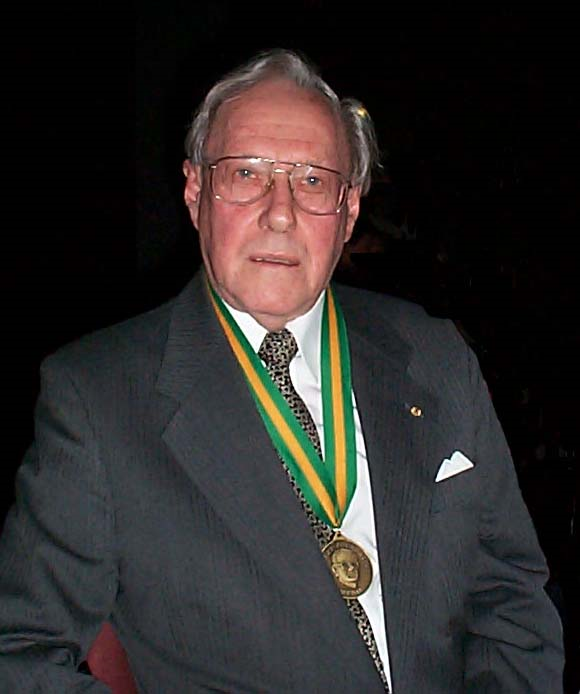
Trevor Robinson AM, wearing his Pearcey Medal awarded in 1999.
related posts
- CIRRUS Emerges!
- Oral History of Australian Computing
- Grandmother of the Web
- Biography - Trevor Pearcey
- Historical Papers
- CSIRAC - Among the First Electronic Stored Program Computers
- Early Australian Internet
- CSIRAC: How to name your computer
- Connections in the History of Australian Computing
- The world’s biggest non-IBM IBM network