The Consumers' Grid - The Data Perspective
Data sits at the heart of every operation of every industry and with the advent of advanced computing the ability to use data to drive
evidence-based decision-making has become central to innovation, development and economic success.
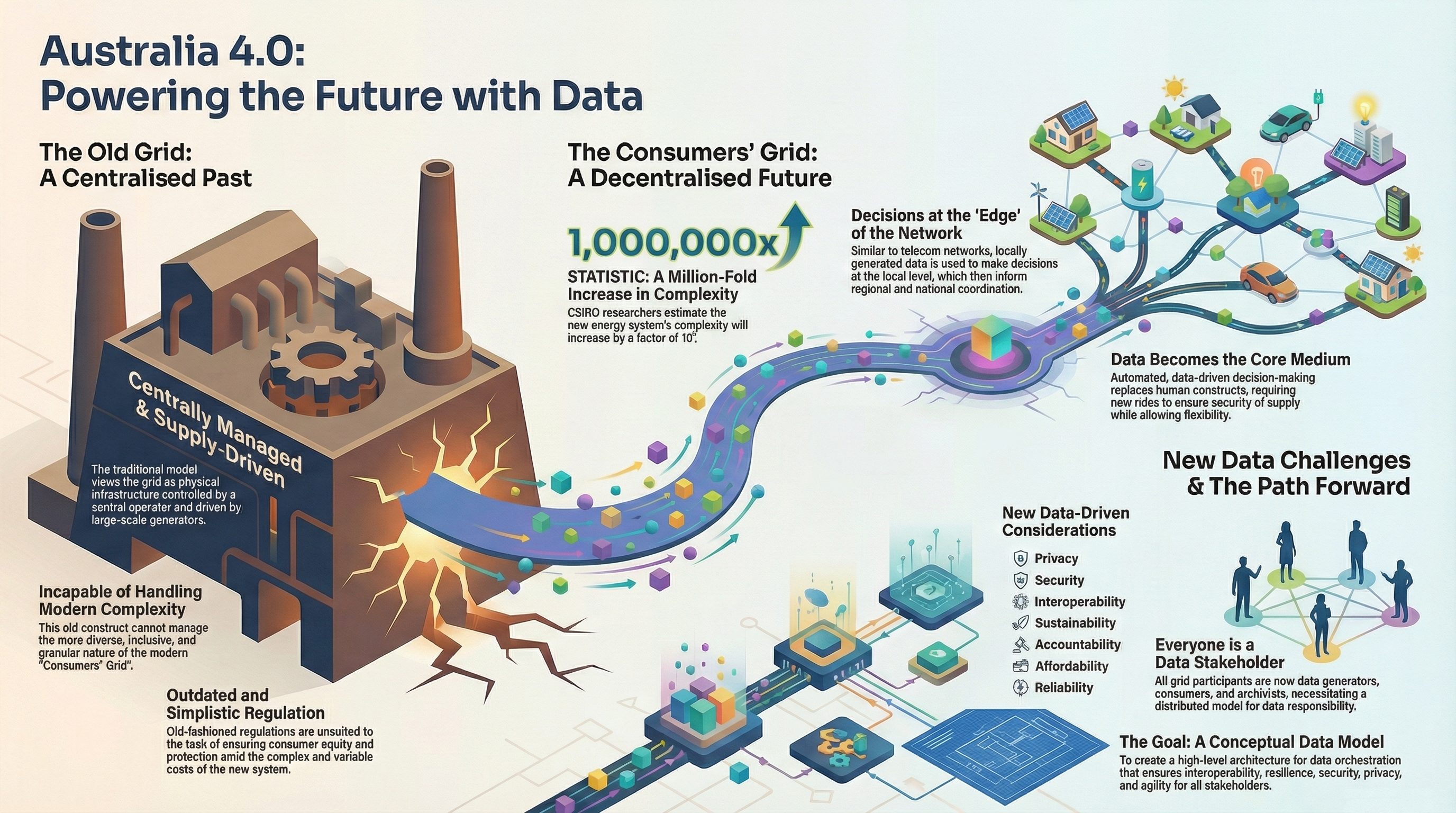
The classical electricity systems were always full of data-driven decision-making. The Consumers’ Grid required for the 21st century is taking that to the next level with CSIRO researchers estimating the complexity of the system will increase by a factor of 106. One key way to deal with the rapidly increasing complexity is to employ more technology-based tools, solutions and decision support systems. The advent of the new wave of AI has enhanced the possibilities for benefiting from digitalisation while accelerating the need for better energy management.
Incumbent energy companies and government regulators appear trapped in the old construct that sees the world through physical infrastructure supporting a centrally managed operations model driven by the supply side (generators). That construct is simply incapable of contemplating the more complex, diverse, inclusive, and granular nature of the Consumers’ Grid.
To command the complexity requires decentralised decision-making similar to the way other automation networks, like the telecommunications network, operate successfully. Locally generated data is used to make decisions at the ‘edge’ of the network even as those decisions and related data flow back through the network to coordinate regional and national decisions. Rules are established to provide guardrails and predictability that ensure security of supply, even while affording flexibility in consumption.
Complexity requires decentralised decision-making
In this more complex system, costs are more complex and more variable making old fashioned simplistic regulation unsuited to the task of mandating consumer equity and protections. The introduction of data as the core medium for automated decision-making, replacing the humans and human constructs, adds new considerations of privacy, security, interoperability, sustainability, accountability, environmental impact, affordability, availability and reliability.
A data model of the electricity system needs to contemplate both the physical and logical layers of the system as well as the data exchange required between and across those layers. Operation must combine real-time, near-real-time, state-change, and architectural decision-making that relies on the relevant data being accessible in temporary, sustained, and permanent data stores.
Evidence-based decision-making at the edge needs fit-for-purpose regulation
The challenges of personally identifiable data, data ownership, data exchange, data storage, and cybersecurity must be considerations at every level of the system. Since all grid stakeholders will now be data generators, data consumers, and data archivists, it is no longer adequate to assume that a central entity will be solely responsible for data. Data responsibility and accountability must be distributed throughout the system with equitable exchanges of data to ensure value is created and shared.
Our goal here is to create a conceptual data model that offers a high-level architecture and orchestration of data, which identifies the needs and opportunities inherent in delivering interoperability, resilience, security, commerciality, privacy, and agility. This model will enable operators, consumers, service providers, regulators, and generators, to enhance governance and understanding of their roles, realise their own objectives, and recognise their interdependence with other stakeholders.